Medal studies and institutional collaboration
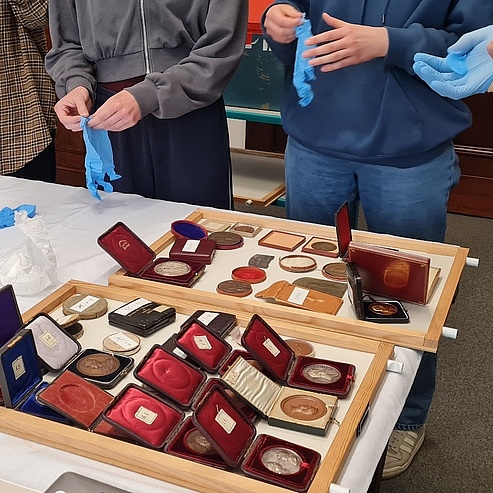
The Humboldt-Universität art collection includes, amongst other things, over 120 medals. A seminar with students at the Berlin Münzkabinett (Coin Cabinet) focused on this particular genre during the summer term.
A complex approach
At first glance, medals often seem unspectacular. Whilst we scarcely give a second glance to the designs on the coins we still hold in our hands in everyday life, medals are at least viewed with curiosity. However, the large proportion of historical medals from the 19th century in the HU’s collection – a selection of which formed the basis of the seminar – is not always easy to decipher. We need to make sense of Latin inscriptions and complex iconographic depictions.
Help from the expert
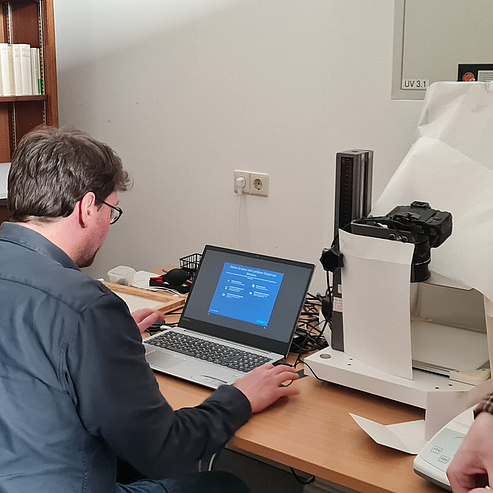
As a correct description of a medal requires much more information – such as the coin’s condition, stamp position, whether struck or cast – and there are standardised guidelines regarding, for example, the reproduction and placement of inscriptions, it is advisable to consult an expert. The seminar took place at the Münzkabinett Berlin, which also has the technical facilities required for professional photographic documentation of the medals. Furthermore, the Münzkabinett’s Online Catalogue (IKMK) of the Staatliche Museen zu Berlin has been operated there since 2007, as has the website ikmk.net (Interactive Catalogues of Numismatic Collections) which serves as a cross-institutional database portal for numismatics in German-speaking countries and currently lists over 167,000 objects. With the first medals now entered into the system, HU is also part of this network of university coin collections in Germany, known as the NUMiD network.
An Approach to a Genre
Thanks to Dr Johannes Eberhardt, a research assistant at the Münzkabinett, the students not only learned how to enter data correctly into the ikmk, but also gained technical and historical knowledge about medals as a genre. Many sessions were characterised by focused work on the artefacts and the database, as well as in the Münzkabinett’s library. For example, it is not immediately obvious that the medal from the University of Lviv, commemorating the 80th birthday of Antoni Małecki, was not produced in the Ukrainian city, but in Vienna. Similarly, the mark on the edge of the medal commemorating the 100th anniversary of the Natural History Museum in Paris first had to be deciphered – a cornucopia symbolising the Monnaie de Paris.
The fact that, conversely, pieces quite different from those previously found in the numismatic portal are now available there – and that new standardised data on medallists and other contributors are being added – highlights the distinctive nature of the HU’s collection. These are primarily commemorative and personal medals from the last 150 years: University and institute anniversaries have been, and continue to be, occasions for striking medals, as are birthdays and honours bestowed upon scientists. Thanks to numerous gifts, the university also possesses various medals from other universities, with a particular focus on South American and Eastern European mintings, amongst others.
Active Contemporary Crafting
A highlight of the seminar was the participation in the 29th meeting of the Berlin Medallists’ Circle. Here, the students had the opportunity to talk with contemporary medallists and gain first-hand insight into techniques and motifs, the challenging market conditions, and the concerns about the future of this uique art form.
The results of the seminar – and with them the first entries in the HU’s ikmk – are now online, featuring examples from Argentina (the International Congress marking the 100th anniversary of the Argentine Revolution and the inauguration of the University of Warsaw); further entries will follow during the semester break. The next step is to further develop the profile of the university’s medal collection by adding supplementary and summary information. A corresponding text, collaboratively written by the students, will then be available in future as an external note. The long-term aim is to catalogue all of HU’s medals in the Münzkabinett and thus make them accessible.
The Artwork of the Month showcases selected pieces from the art collection. Each month, one or more objects are highlighted to provide insights into material culture, the history of the collection and academic contexts. The articles examine the provenance, design and significance of the objects from various angles and highlight the broader issues they raise. In this way, they open up new perspectives on historical developments, cultural practices and current research interests associated with the art collection.