Profile
For almost 200 years, the University Library of Humboldt-Universität zu Berlin has been providing students, lecturers and researchers with the specialist literature they need for their studies and research. Today, it is one of the most visited academic libraries in Germany. The majority of the acquisitions budget is spent on online resources. Open Access is a key area of focus in the context of publishing and access to literature. Consequently, the University Library is one of the founding members of Berlin Universities Publishing (BerlinUP), the collaborative open-access publisher within the Berlin University Alliance (BUA). In addition to providing information, the library serves as an important venue for in-depth academic exchange.
Literature provision
From textbook collections to specialist databases, the University Library supports all teaching and research activities, from the start of a student’s degree to cutting-edge research. In doing so, it focuses on up-to-date content, modern formats and innovative acquisition models.
Information literacy
The University Library’s wide range of training courses extends from introductory library sessions such as ‘All About the Library: Getting Started with Your Studies’ through to introductions to reference management software and one-to-one research coaching. The Actionbound app also allows users to familiarise themselves with the library’s locations in a fun and personalised way.
Subject departments
Through a dense network of subject librarians, expert and personalised support is available at every location and for every subject area across all services: for example, literature requests, introductions to research, guided tours of the library, collaboration on first-year orientation programmes, and advice on electronic publishing and research data management.
Open Access refers to free access to academic literature, meaning that it is available digitally, free of charge and publicly accessible, and can be used without technical or legal barriers. The benefits of Open Access include global free access to research findings, increased visibility and citation rates, long-term availability, and the retention of exploitation rights by the authors.
The University Library supports researchers at HU by offering:
- Publication opportunities on the institutional repository, including for doctoral theses
- Publication opportunities through our open-access publisher, Berlin Universities Publishing
- Funding for Open Access publications
- Individual advice and workshops
As part of the system of DFG-funded Specialised Information Services (FID), the University Library is committed to providing rapid and direct access to specialist literature and research-relevant information. This enables the University Library to offer supra-regional services, including those relating to research data management.
FID in Social and Cultural Anthropology
The University Library takes the lead in managing the FID in Social and Cultural Anthropology. It offers services and advisory support for research and, through the specialist portal EVIFA, provides a centralised entry point for information retrieval and research.
FID Educational Science and Educational Research
The University Library is one of five partners in the Subject Information Service for Educational Science and Educational Research and continues the work of the former Special Collection Area for Higher Education.
FID Gender
The University Library is one of a total of six participating institutions in the FID Gender. The FID Gender offers a wide range of services as well as advisory and research resources.
The University Library’s historical collections and special collections are available as resources for teaching and research. The majority of these are housed in the Grimm Centre. The Research Reading Room offers doctoral researchers and staff at HU a special space in which to work undisturbed. The reference library on the history of science and the scholars’ libraries are freely accessible there.
Subject-specific collections are distributed across other locations. Among the University Library’s most significant collections is the private library of the Brothers Grimm. Other collections include:
- Archive of the literary society ‘Tunnel über der Spree’ (relating to Theodor Fontane)
- Portrait collection of Berlin university lecturers
- Collection of medieval documents (Koppscher Apparat)
- Leopold Hirschberg’s bibliophile collection (literature from the Goethe era)
- The Haeberle-Hirschfeld Archive for Sexology.
The special collections are being retro-digitised on an ongoing basis and published in the University Library’s Digital Collections.
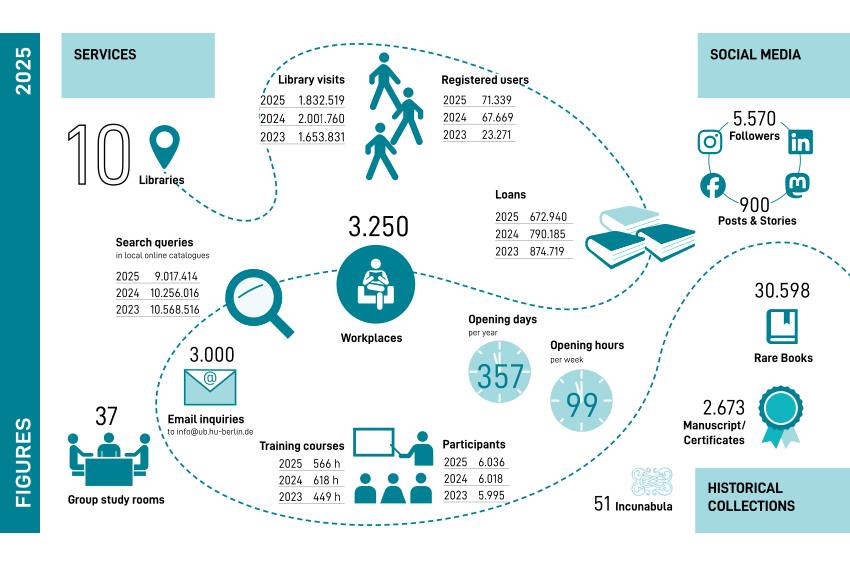
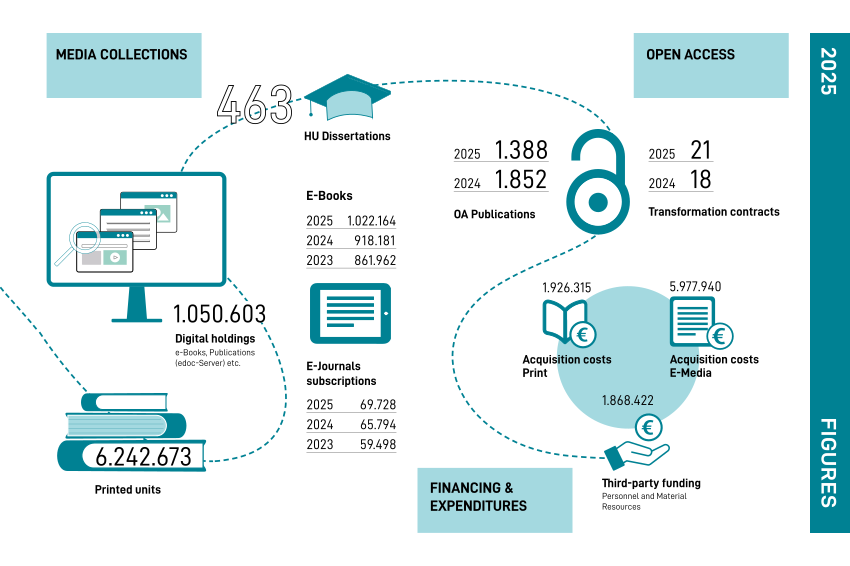
The University Library in figures
UB2035 Strategy
From June 2024 to June 2025, the University Library of Humboldt-Universität zu Berlin focused on its future as part of the UB2035 strategy project. The result is a strategy paper in which we have set out the key priorities of our work for the coming years.
The University Library’s vision for the future: shaping knowledge, opening up spaces
The University Library sees itself as a place where knowledge is created, exchanged and preserved. It also aims to be a place for collaboration, interaction and networking. It facilitates open and reliable access to academic findings and regards itself as a competent and indispensable partner to the academic community.
The Roadmap to UB2035
To realise its vision for the future, the University Library has drawn up a roadmap. This comprises ten key areas of action:
- The University Library for Humboldt-Universität: The University Library is a reliable service provider for the whole of HU and aligns its further development with the needs of HU.
- Development of services tailored to needs: The University Library consistently tailors its services to the needs of its target groups. To this end, it will in future implement a service portfolio management system and conduct usage research.
- Open learning, study and meeting spaces: The University Library bears primary responsibility at HU for the supervised and structured provision of learning, study and meeting spaces.
- Research-related services for open science: The University Library supports research through a wide range of services. It is committed to the further development of open science and serves as the central hub for publication services at HU.
- Digital transformation at the University Library: The University Library is actively shaping digital transformation by creating a digital environment and promoting digital skills. It is digitising its holdings as well as the HU’s historical records (Digital Archive) and plays a central role in the digitisation of collections at the HU and the BUA.
- Sustainability: The University Library sees itself as a ‘Green Library’ and strives to act in a socially and technologically sustainable manner.
- Internationalisation: The University Library is committed to offering its services consistently in two languages (English/German) and invests in the multilingualism of its staff.
- Social responsibility for diversity and democracy: The University Library regards libraries as places where democracy is put into practice. It stands for diversity and openness. Its services are accessible to all.
- Flexible and functional organisational structures within the University Library:The University Library sees itself as a learning organisation with functional structures, characterised by clear responsibilities and standardised work processes.
- The University Library as an attractive and sustainable place to work: The University Library is placing greater emphasis on strategic staff development through targeted initial training, further training and professional development, particularly for its managerial staff. There is a shared understanding of leadership as well as ongoing team development.
Strategy of the University Library of Humboldt-Universität zu Berlin
About the UB2035 project
The University Library’s strategy was developed from June 2024 onwards as part of the one-year UB2035 strategy project. There were dedicated project bodies (steering group, project team) which addressed the strategic and operational aspects of the project. We also had a focus group, consisting of University Library staff, who provided feedback on the progress of the project and the content developed. The project received advisory support from artop. At regular intervals, all University Library staff and other members of the Humboldt University community were involved through workshops or information sessions. Despite this clear direction, the project allowed for adjustments. We therefore learnt a great deal during the process itself about what the project needed next and responded flexibly as we went along. By the end of the project in June 2025, the first measures had been designed or were already in place. The strategy paper provides a clear plan for the next steps in implementing the strategy. With the strategy now in place, the University Library is moving into a new phase of implementation and organisational development.
Contact
Throughout the project, we have repeatedly found that dialogue with members of the HU community and other libraries has been extremely enriching for the process. You are therefore warmly invited to get in touch with us!
The University Library’s management and the heads of department played a key role in developing the strategy. You can find their contact details here. The project was led by the Director of the University Library, Martin Lee.