Notable collections
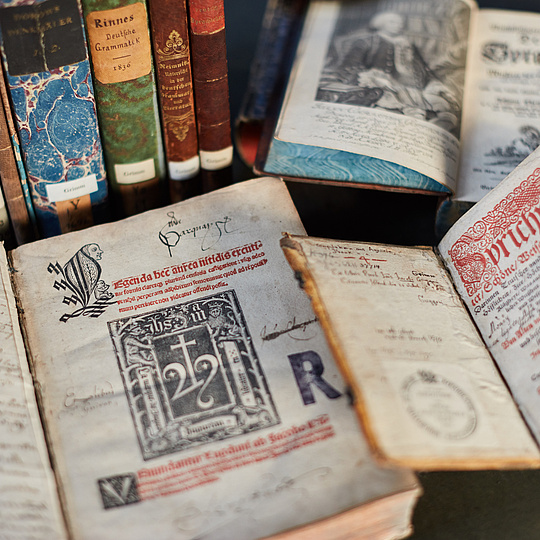
The University Library (UB) holds a wide range of special collections and historical sources. Many of these collections are available in digital form. You can find information about our historical collections and special collections on our website.
Notable collections
The University Library (UB) holds a wide range of special collections and historical sources. Many of these collections are available in digital form. You can find information about our historical collections and special collections on our website.
Provenance research at the HU
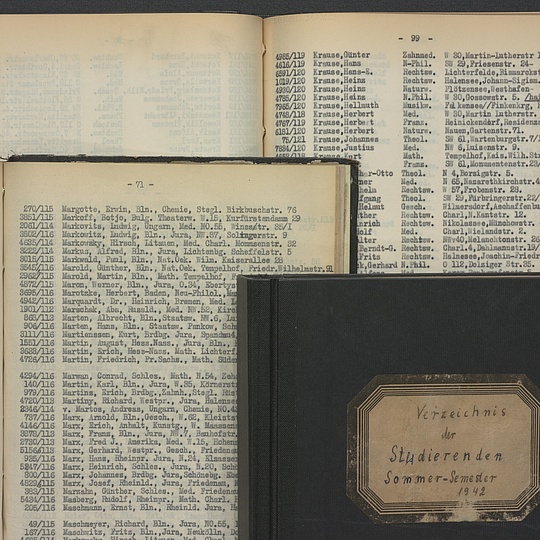
Where do our books come from? The history of a book’s provenance – for example, its previous ownership by scholars – is recorded by the University Library as valuable information for the history of science. Another key focus of provenance research at the University Library is to uncover unlawful acquisitions during the Nazi era, to document looted material and, where possible, to return it.
Provenance research at the HU
Where do our books come from? The history of a book’s provenance – for example, its previous ownership by scholars – is recorded by the University Library as valuable information for the history of science. Another key focus of provenance research at the University Library is to uncover unlawful acquisitions during the Nazi era, to document looted material and, where possible, to return it.
An overview of all historical and special collections
Available for consultation on request in the Grimm Centre’s Research Reading Room.
Of the originally more extensive collection of ancient manuscripts that found their way into the University Library during the 19th century, the library now preserves only a few Western manuscripts, which can be searched for separately in thesearch portal via a brief catalogue entry. A more detailed description is available in the Manuscripta Mediaevalia manuscript database.
The collection comprises approximately 1,400 autographs. The majority of the autographs date from the 19th and early 20th centuries.
The collection is listed in the Kalliope union catalogue. The records include, amongst other things, the authors, the addressees, a large proportion of the individuals mentioned in the letters, and a brief summary of the content of each document. Please enter your search term in Kalliope. From the search results, filter the available holdings using ‘Institutions holding the collection’ and ‘University Library (Berlin, Humboldt-Universität zu Berlin)’.
Access
In Kalliope, you can search for the letter you require as described and order it via rara☞ Please insert an @ at this point ☜ub.hu-berlin☞ Please insert a period at this pointde, quoting the letter details or the record number (e.g. DE-611-HS-36682890). The item is usually made available on the next opening day (excluding Saturdays). The autographs may only be consulted in theResearch Reading Room.
Bibliography
- Elke Peschke and Henrik Hofer, ‘Selected Special Collections of the University Library’, in: *Theatrum naturae et artis – Theatre of Nature and Art*, vol.: *Essays*. Cabinets of Curiosities of Knowledge, 2000, pp. 186–196, see pp. 195 ff.
- Henrik Hofer, ‘The University Library’s Autograph Collection’, in: *Theatrum naturae et artis – Theatre of Nature and Art*, vol.: Catalogue. *Cabinets of Curiosities of Knowledge*, 2000, pp. 55–57
- Henrik Hofer, “Do You Know Anything About Hertz?”. On New Acquisitions in the University Library’s Autograph Collection, in: Humboldt 51(2006/2007)5, p. 8
The collection comprises specialist literature from the estates of the Berlin physicians Emil Osann (1787–1842), Stephan Friedrich Barez (1790–1856) and Hermann Ludwig Helfft (1819–1869).
Emil Osann is regarded as the founder of scientific balneology. The collection comprised approximately 1,100 works.
The collection may be consulted by appointment in theResearch Reading Room of the Grimm Centre. A list of the holdings already catalogued is available via the Primus search portal.
August Boeckh’s (1785–1867) library is the largest scholarly library bequeathed to the University of Berlin, and is exceptionally extensive for a professor’s library of its time. A selection of items, in particular those containing handwritten entries, has been digitised.
Size: originally 12,000 volumes, of which approximately 2,500 have now been catalogued.
Access is available by appointment in the Research Reading Room of the Grimm Centre. A list of the holdings already catalogued is available via the Primus search portal.
Collection of the Germanist and folklorist Johannes Bolte.
Available for use by appointment in the Research Reading Room of the Grimm Centre.
Size: approx. 670 volumes
The library of Aleksander Brückner (1856–1939), Professor of Slavic Languages and Literary History at the University of Berlin.
Aleksander Brückner served as Professor of Slavic Languages and Literatures in Berlin from 1881 to 1924. His estate comprises, in particular, works on Polish literary and cultural history, but also on other Slavic philologies.
The size of the catalogue already recorded: 477 titles, which can be searched for via the Primus search portal. The collection is being continuously expanded.
Much of the collection of the former Museum of Christian Archaeology and Art (founded in 1849) was lost during the Second World War. The surviving parts now form part of the collections of Humboldt-Universität. A large proportion of the museum’s library is now housed in the Theology Branch Library.
Size: 5,050 volumes
The study library of the historian and university professor Johann Gustav Droysen (1808–1884).
Size: approx. 1,500 volumes
Access is available by appointment in the Research Reading Room of the Grimm Centre. A list of the holdings already catalogued is available via the Primus search portal.
The University Library’s collection of pamphlets and leaflets relating to the March Revolution and its political consequences was established in the 1990s through the extensive acquisition of second-hand material comprising a ‘documentary collection on the history of the German Revolution of 1848/49, with a focus on Berlin’ in the 1990s, which has been fully digitised in recent years. Other parts of the collection stem from acquisitions made in the 19th century.
Leaflets and pamphlets have been printed since the early 16th century and are regarded as the first mass medium to refer to current events and to aim at shaping or influencing public opinion.
Scope: around 1,600 items, including caricatures, picture sheets, wall posters and pamphlets.
The leaflet collection can be searched via the Primus search portal and is largely available in digital form. Access is available on request in theResearch Reading Room of the Grimm Centre.
The banker Paul Hermann Emden (1882–1953) collected materials and books relating to Theodor Fontane, including numerous first editions by the writer. The collection was donated to the Berlin University Library in 1930.
These are the books from the Fontane Collection; the material from the collection that is not in book form is held on permanent loan at the Fontane Archive in Potsdam. The ‘Fontane Evening’ in Berlin, co-founded by Emden in 1927, had acquired his collection and donated it in 1930 to the Berlin University Library, which was about to celebrate its centenary. Among the nearly 350 volumes in the Fontane Library are (first) editions of Fontane’s works as well as secondary literature about him.
Access is available on request in the Research Reading Room of the Grimm Centre. A list of the titles in the collection is available via the Primus search portal.
Size: approx. 350 volumes
Library of Robert Gragger (1887–1926)
, Professor of Hungarian Language and Literary History and founder of the Hungarian Department at the University of Berlin. Size of the catalogue: 743 titles (searchable via the Primus search portal)
Following their deaths, Jacob and Wilhelm Grimm’s professional and private library was purchased by the Prussian State for the University Library. It reflects the Grimm brothers’ wide-ranging scholarly activities, their research projects and their academic network. Through dedications, acquisition notes, handwritten annotations and underlinings, the library serves as a valuable source for the history of scholarship.
Access is available by appointment in the Research Reading Room of the Grimm Centre. A list of the holdings already catalogued is available via the Primus search portal.
Size: approx. 6,000 volumes
Part of the library is currently being digitised.
The Haeberle-Hirschfeld Archive for Sexology (HHA) is one of the University Library’s special collections. The HHA primarily contains literature on sexology within the context of the humanities and social sciences.
Monographs and journal titles from the HHA collection can be searched for via the Primus search portal and ordered there by registered users. The ordered items will be made available to you in theResearch Reading Room for on-site use. Details regarding the availability of the items can be found in your user account.
In addition, an internal database lists approximately 40,000 entries for individual articles in monographs and journal volumes held by the HHA. Research in this database can be facilitated by prior appointment.
The HHA’s archive holdings have not yet been catalogued or indexed. Only small sections are permitted for use, subject to individual assessment. The University Library’s terms of use are supplemented by special regulations applicable to the HHA. Please note that an application form must be completed in order to access the archive holdings.
Wolfgang Heise (1925–1987) was Professor of Philosophy at Humboldt-Universität until his retirement in 1985. The Heise Archive at the University Library comprises 30,000–35,000 sheets of documents (private and professional correspondence) and 7,325 books from Heise’s library.
The majority of the library is available for open-shelf browsing in theResearch Reading Room of the Grimm Centre and can be viewed immediately upon request at the service desk. The book holdings have been digitised and can be searched via the Primus search portal
Scope: approx. 7,000 books
The archive collection comprises the scholarly estate of the philosopher, essayist and professor of the history of aesthetics. The Wolfgang Heise Archive consists of approximately 35,000 sheets of private and professional correspondence and is accessible on request. The materials can be searched via the finding aid.
The collection, acquired in 1913 from the Berlin-based bibliophile, doctor and musicologist Leopold Hirschberg (1867–1929), comprises German national literature from 1750 to 1850, including numerous first editions.
Access is available by appointment in the Research Reading Room of the Grimm Centre. A list of the holdings already catalogued is available via the Primus search portal.
Size: approx. 12,000 volumes
The collection includes an extensive range of historical maps, aerial and landscape photographs, as well as portraits and individual archival documents relating to individuals associated with the Department of Geography at the University of Berlin.
Materials from the Historical Geography Collection can be consulted in the Grimm Centre’s Research Reading Room by prior arrangement. Please direct any enquiries regarding the collection or requests to use it to rara☞ Please insert an @ at this point ☜ub.hu-berlin☞ Please insert a period at this pointde.
From its foundation until the collection was completed in 1998, the University Library collected academic theses, predominantly from German-speaking countries.
The Academic Exchange Association, founded towards the end of the second decade of the 19th century, established exchange relationships for the University of Berlin – which was a member – and its library; these remained of great importance for the acquisition of academic theses right up until the second half of the 20th century. Regulations on legal deposit in favour of the University of Berlin were subsequently introduced: in 1838 for all Prussian school and university publications, and in 1885 for all German academic publications. In addition to doctoral theses, habilitation theses and school programmes, the collection also includes rectorial addresses and other academic occasional writings.
The holdings of this special collection also include items from France, the Netherlands, the USA, Switzerland and the Scandinavian countries.
University publications must generally be ordered from the stacks. They may be consulted on the premises of the Grimm Centre. In some cases, the volumes may be borrowed to take home.
Size: over 1.2 million items
Bibliography
- Rudi Möbus, ‘Working with University Publications at the Berlin University Library: Past and Present’, in: Contributions to the Work of the University Library: Past and Present, Berlin 1980, pp. 83–97
- Erich Stietz, ‘The School Syllabus Collection at the Berlin University Library’, in: *From the Work of the University Library*, Berlin 1971 (Berlin University Library Series 7), pp. 23–33
A collection with changing locations: The Hofmann Library
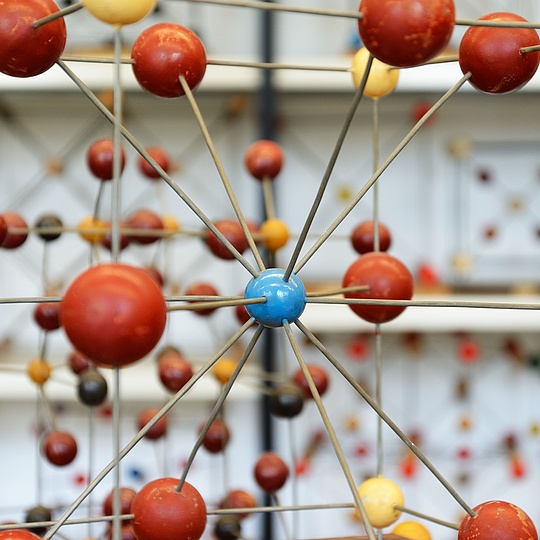
Named after its founder, the library of the former German Chemical Society has gained worldwide recognition. The collection’s eventful history reflects the social conditions of its time.
August Wilhelm von Hofmann (1818–1892) was one of the most renowned chemists of his time. After studying under Justus von Liebig in Giessen, he went to London, where he helped establish the Royal College of Chemistry. In England, Hofmann came to understand the close interrelationship between chemistry as a science and its technical applications. The mediating role played by the Royal Society of Chemistry was a formative experience for him. Upon his return to his homeland, Hofmann took over the chair of chemistry from Eilhard Mitscherlich at the University of Berlin. Here he demonstrated his outstanding abilities not only as a university lecturer and researcher, but also as an organiser of scientific affairs. In 1867, he founded the German Chemical Society (DCHG), whose members included Robert Wilhelm Bunsen, Justus von Liebig and Friedrich Wöhler, amongst others. Today, this professional organisation, known as the German Chemical Society (GDCh), has more than 27,000 members.
One of the DCHG’s key achievements was the establishment of a large central library for chemistry. Owing to the Society’s limited financial resources (circumstances were evidently no different then than they are today!), the library’s development initially proceeded solely through book donations and exchanges involving the *Berichte der Deutschen Chemischen Gesellschaft*. Ten years later, the books of the late Alphons Oppenheim – who is largely unknown today – were added as a special collection, and in 1893 the valuable bequest of August Wilhelm von Hofmann was incorporated into the library, which ultimately gave the library its name. Whereas handwritten ownership entries and dedications had previously sufficed, it was now time for the first stamp, including an inventory number: ‘German Chemical Society – Berlin W10 – Sigismundstr. 4’. Following the establishment of a discretionary fund in 1889, the library was able to acquire the most important new publications; by the time of the Second World War, its collection had grown to a total of just over 8,000 volumes.
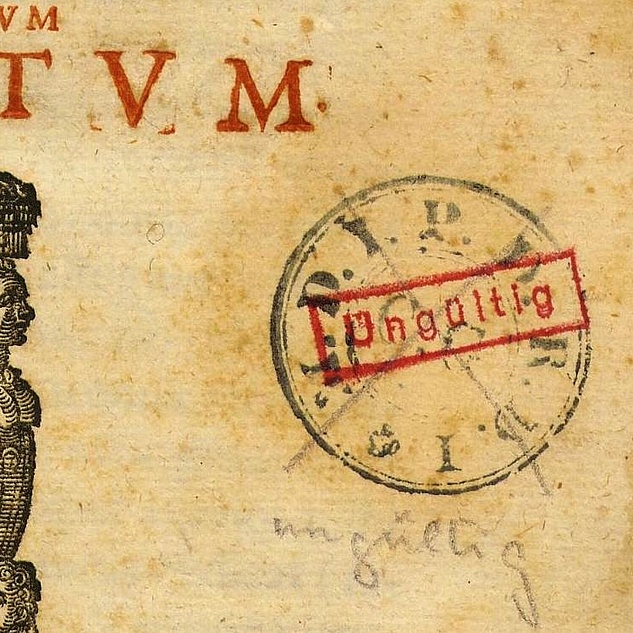
Fortunately, the library was evacuated in good time during the Second World War; the building was completely destroyed. However, storage at the Rüdersdorf lime works did not do the books any favours. The books were subsequently ‘rescued’ and sent to Moscow. This is documented by stamps in Cyrillic letters: ‘Academy of Sciences of the USSR – Library – Chemistry Department’. In some cases, stamps from individual institute libraries can also be found. However, as is customary in libraries, the previous owner’s ownership stamps were always invalidated, in this instance with a red pen or by blacking them out. Evidence suggests that this did not happen until 1953 and was therefore short-lived, as in 1956 the bulk of the library was returned to Berlin and placed under the care of the Chemical Society of the GDR, which had been founded after the war. And yet another stamp? Strangely enough, not this time; nor were the Moscow stamps altered. Instead, the books were catalogued: alphabetically in a card catalogue and subject-wise according to a highly detailed classification system created specifically for this purpose, which was also noted inside the books. In 1990, the circle was complete: following the dissolution of the Chemical Society of the GDR, the library returned to the source of its original collection. It is now part of the Science Branch Library at Humboldt-Universität as the ‘Hofmann Library’ collection, and we, too, have stamped the books (for the first time on the back of the title page) and assigned them a new inventory number.
The collection is of inestimable value and can be characterised as homogeneous. The two estates mentioned constitute the most significant part, not only from the perspective of the history of science but also from a cultural-historical point of view, and according to our research, some of the books held here cannot be found anywhere else. Several hundred volumes, published between the 17th and 19th centuries, are regarded as rarities. Here, alongside the most important handbooks of the period, one finds, for example, first editions by Johann Christian Polycarp Erxleben, Leonhard Euler, Georg Christoph Lichtenberg, Alexander von Humboldt and others. Fortunately, works by members of Hofmann’s circle of friends and acquaintances have also been preserved. Consequently, the complete works of Friedrich Wöhler, Justus von Liebig, Gustav Magnus, Eilhard Mitscherlich, Jöns Jacob Berzelius and others are almost entirely represented. The new publications acquired through purchase reflect the development of chemistry from the turn of the century up to the Second World War.
Text: Julia Fontius / Dr Bernd Fichte
The titles may be used for academic purposes; requests must be made via our search portal, Primus. Access is provided exclusively for on-site use.
The collection consists of items transferred from the so-called Royal House Library at the Hohenzollern Palace in Berlin to the University Library between 1892 and 1928. Since 1862, this library had brought together the private library collections of the Prussian kings and emperors from the 19th and 20th centuries, including those of Frederick William II, Frederick William III, Frederick William IV, Emperor Frederick III, as well as Wilhelm II and his wife, Empress Auguste Viktoria.
Access is available by appointment in the Research Reading Room of the Grimm Centre.
Size: approx. 725 items
Bernhard Hübler (1835–1912) was a university professor of law. As a professor at the University of Berlin, he lectured on canon law from 1880 onwards and published articles on this subject in numerous journals.
Available for use by appointment in the Research Reading Room of the Grimm Centre.
Size: approx. 500 volumes
Wilhelm von Humboldt’s linguistic library is one of the first bequests received by the University Library. Humboldt collected highly specialised literature, including many obscure works – for example, on the indigenous languages of North America, grammars and linguistic artefacts – which he used for his studies. The approximately 239 surviving volumes, many bearing Humboldt’s handwritten notes and marked with a bookplate, are fully catalogued in the Primus search portal.
Access is available on request in the Research Reading Room of the Grimm Centre. A list of the holdings already catalogued is available via the Primus search portal.
Size: 252 volumes
Bibliography
- Christa Schwarz, *Ex Libris a Guilelmo L. B. de Humboldt legatis*. Wilhelm von Humboldt’s bequest to the Royal Library in Berlin, Paderborn [et al.] 1993
Incunabula are the earliest products of the art of printing, published from the time of its invention in the mid-15th century up to and including the year 1500. The University Library’s collection contains approximately 50 copies. The collection is also listed in the General Catalogue of Incunabula (GW), which records all 15th-century prints in alphabetical order. In addition to the printed edition, which is available in the Research Reading Room under the call number AN 22050, the General Catalogue of Incunabula is also available online.
Size of the collection: 54 copies
You must order the work you require via the Primus search portal. It is advisable to register in advance via rara☞ Please insert an @ at this point ☜ub.hu-berlin☞ Please insert a period at this pointde. The holdings are made available exclusively in theResearch Reading Room for on-site use.
Bibliography
Ernst Voulliéme, The Incunabula of the Royal Library and Other Berlin Collections (Museum of Decorative Arts, Cabinet of Engravings, University Library, Graues Kloster, Joachimthal Grammar School, etc.), (Supplement to the Zentralblatt für Bibliothekswesen, 30), Leipzig 1906
The library of the history professor Philipp Jaffé (1819–1870), which mainly contains historical source materials.
In 1870, the medievalist Philipp Jaffé bequeathed his valuable collection of sources on diplomatics, as well as part of his estate, to the university.
Access is available by appointment in the Research Reading Room of the Grimm Centre. The volumes identified to date are listed in the Primus search portal.
Size: approx. 1,500 volumes
The writer and translator Janheinz Jahn is regarded as the most important promoter of African and Caribbean literature in post-war Germany. His extensive literary estate includes, amongst other things, short stories, essays, radio features and a large number of translations of African and African-American works. The collection was acquired in 2005 by the Department of African Studies – where it forms the focus of academic and editorial work – and is now held in the University Library. The collection has been fully digitised.
Scope: approx. 8,000 letters
Access is available by appointment in the Grimm Centre’s Research Reading Room.
The majority of the acquired collection is housed in the open-access section on the 6th floor.
Size: several hundred volumes
- Collection currently being processed -
The lecture notes contain students’ handwritten transcripts of historical lectures, predominantly from lectures held at the University of Berlin in the 19th and 20th centuries. The collection comprises several hundred items. A large proportion of the lecture notes has already been digitised.
They may be consulted by appointment in the Research Reading Room of the Grimm Centre. A list of the holdings already catalogued is available via the Primus search portal.
Some of the notebooks are also held in the rare book collection at the Natural Sciences branch library.
Scope: approx. 400 titles
The sports educator Hermann Otto Kluge (1813–1882) was born in Berlin, the son of the physician Karl Alexander Kluge. He initially worked as a chemist. From 1851 to 1860, he took up a post as a gymnastics instructor at the newly founded Royal Central Gymnastics Institute, where he worked alongside the gymnastics educator Karl Wassmannsdorff. Kluge was also a gymnastics instructor with the Berlin professional fire brigade. From the 1870s onwards, he focused on the development of gymnastics apparatus and the fitting out of gymnasiums. The collection contains Kluge’s autographs, drawings and choreographies, alongside works by other authors on 19th-century sport and leisure culture, and bears witness to the emergence of modern sports science.
The scholarly library has been fully digitised. A list of the fully catalogued holdings is also available via the Primus search portal.
Size: approx. 265 volumes
Books from the library of Germany’s first female professor of German studies, Agathe Lasch (1879–1942), which was confiscated by the Nazis in 1942.
The books from the library of Germany’s first female professor of German studies, Agathe Lasch, which are held in the Humboldt-Universität University Library, can be searched for via the Primus search portal. There are 60 titles, taken from the original 4,000 volumes that made up Agathe Lasch’s library, which was confiscated by the Nazis in 1942.
Access is available by appointment in the Research Reading Room of the Grimm Centre.
Scope: approx. 60 titles
Bibliography
- Sonja Kobold and Matthias Harbeck, “From Agathe Lasch’s Library” – Provenance Research at the University Library of Humboldt-Universität zu Berlin, Berlin 2008 (Publication Series of the University Library of Humboldt-Universität zu Berlin 63)
Correspondence of the cultural psychologist Moritz Lazarus (1824–1903)
The collection of letters comprises 1,366 items.
The collection is listed in the Kalliope union catalogue. Please enter your search term there. From the search results, filter the available holdings using ‘Institutions holding the collection’ and ‘University Library (Berlin, Humboldt-Universität)’.
You must locate the desired letter in Kalliope as described above and order it via rara☞ Please insert an @ at this point ☜ub.hu-berlin☞ Please insert a period at this pointde, quoting the call number or record number (e.g. DE-611-HS-3668290).
Access is available on request in the Research Reading Room of the Grimm Centre.
Bibliography
- Elke Peschke and Henrik Hofer, ‘Selected Special Collections of the University Library’, in: *Theatrum naturae et artis – Theatre of Nature and Art*, vol.: *Essays*. Cabinets of Curiosities of Knowledge, 2000, pp. 186–196, see pp. 193–195
The estate of the Catholic dogmatist and Bishop of Mainz, Cardinal Karl Lehmann (1936–2018), comprises, in particular, volumes on Catholic dogmatics and ethics, as well as on Christian social teaching and pastoral theology.
The holdings, which are kept at the University Library of Humboldt-Universität, form part of the estate of Cardinal Karl Lehmann (1936–2018), who, during his time as a professor in Mainz and Freiburg and as Bishop of Mainz, amassed an extensive private library consisting mainly of theological literature. They were donated to Berlin by the Diocese of Mainz in 2021 and complement the collection of the Theology Branch Library, which had previously been geared predominantly towards the needs of Protestant theology. Among other things, this enables the library to be better aligned with the research and teaching of the Institute for Catholic Theology (IKT), which was newly founded in 2019.
Approximately 12,000 volumes were acquired, focusing in particular on fundamental theology, Catholic dogmatics and ethics, as well as Christian social teaching and pastoral theology. In addition to standard works of Catholic theology, the collection also includes more recent specialist literature in German and other languages – predominantly Italian and French. Some of the books came into Cardinal Lehmann’s possession as gifts.
Mostly part of the open shelves of the Theology Branch Library
Size: 12,000 volumes (searchable via the Primus search portal)
The medical history library of Ernst von Leyden (1832–1910), a physician and director of the First Department of Medicine at the Charité.
Access is available by appointment in the Research Reading Room of the Grimm Centre.
Size: 174 volumes
Franz von Liszt (1851–1919) – a cousin of the famous composer of the same name – is regarded as one of the most important scholars of criminal law in the German-speaking world of the late 19th and early 20th centuries. Since 2008, the Institute for International Criminal Law at the HU has been named after him.
This historic special collection on criminal law (formerly the Criminal Law Library until 1945)is now housed in the Jacob-und-Wilhelm-Grimm-Zentrum and is currently being catalogued. The collection can be accessed on request via Primus in the Research Reading Room.
Size: approx. 12,500 items (from the Criminal Law Seminar and half from private collections)
At both national and European level, Liszt campaigned for comprehensive reforms of criminal law and the prison system. Politically, he belonged to the left-liberal camp: from 1912 to 1918, he served in the German Reichstag as a member of the Progressive People’s Party.
The ‘Criminalistics Seminar’, founded by Liszt in Marburg in 1887–88, later moved to Halle and then to Berlin in 1899 upon his appointment to the University of Berlin (renamed the ‘Criminalistics Institute’ in 1913) was renowned for its library, which was outstanding in both scope and quality and consisted largely of Liszt’s private collection. In 1912, Liszt donated his collection to the University of Berlin, which continued to expand it even after Liszt’s retirement (1917) and his death (1919), establishing it as a specialist library on international criminal law that is highly regarded worldwide. By 1929, the collection comprised approximately 30,000 volumes.
Despite significant losses during the Second World War, the library’s core collection has been preserved and has been housed at the Grimm Centre (GZ) since 2012.
Two specialised historical catalogues index the holdings of the Criminal Law Library: the alphabetical card catalogue, which is freely accessible on the 5th floor of the GZ (diagonally opposite the information desk), and the systematic volume catalogue, which is located on the 6th floor of the GZ in the Historical Collections department and can be consulted there on request. It is only possible to determine to a limited extent which titles from the Liszt Collection have been preserved and which have been lost from the loss notes in both catalogues.
If you are planning extensive research in the collection, we recommend booking in advance at: rara@ub.hu-berlin.de.
Literature on history, philosophy, linguistics (particularly French and German), theology, education, collections of fairy tales and poetry. A large proportion of the works in this private library are extremely rare.
Access is available in the Research Reading Room at the Grimm Centre. A list of the holdings already catalogued is available via the Primus search portal. A large proportion of the library is on open-shelf in the Research Reading Room and can be viewed immediately in the reading room upon request at the counter.
Size: approx. 1,200 volumes
A unique collection of public health regulations, drug price lists, medical prescriptions, writings on accident and rescue services, and other sources relating to the history of medicine. The Berlin physician George Meyer (1860–1923) is regarded as a pioneer of emergency medicine and the ambulance service.
Access is available by appointment in the Research Reading Room of the Grimm Centre.
Scope: several thousand items
Mainly books from the 19th and early 20th centuries from the collection of the medieval Germanist. Muellenhoff (1818–1884) was Professor of German Philology at the University of Berlin from 1858.
Access is available by appointment in the Research Reading Room of the Grimm Centre or in the German Studies branch library. The volumes identified to date are listed in the Primus search portal.
Size: approx. 350 volumes
The collection of 52 Arabic, Persian and Ottoman Turkish manuscripts, now held at the University Library of Humboldt-Universität zu Berlin, dates back to the study collection of Julius Ruska (1867–1949), who held a chair in the history of the natural sciences of the Orient at Heidelberg University.
The collection consists predominantly of works on mathematics, astronomy and alchemy. In addition to original manuscripts, the collection contains numerous reprographs from European and Turkish libraries. To date, these have only been catalogued via the printed catalogue.
During the 2024 update, the numerical classification system of the printed catalogue was retained and supplemented with ‘Hsr. or.’ to form a call number.
All the original manuscripts are catalogued on the specialist portal qalamos.net.
History of the collection
The Institute for Natural Sciences, headed by Julius Ruska in Heidelberg, was relocated to Berlin in 1927 at his instigation, where it was housed in the Berlin City Palace. A few years later, it was affiliated with the newly founded Institute for the History of Medicine and the Natural Sciences, which was intended to establish a new research focus in Berlin. Paul Diepgen, a gynaecologist and historian of science from Freiburg, was appointed director. Diepgen attached great importance to a thematically diverse and comprehensive library with a cultural-historical focus. By 1940, the collection comprised 80,000 items, but suffered considerable losses during the Second World War, not least due to the relocation of holdings. Administratively, the library was transferred to the University Library in 1973 and, together with its manuscript collection, moved into the Jacob-und-Wilhelm-Grimm-Zentrum in 2008.
The collection had already been catalogued and described in a printed catalogue as early as 1939. A large part of the collection originates from the estate of the mathematician and astronomer Carl Schoys (1877–1925), a lecturer at the universities of Bonn and Frankfurt. Further manuscripts and copies were acquired in Cairo through the mediation of Max Meyerhof, who practised as an ophthalmologist in Cairo from 1903 onwards and was a collector of manuscripts.
Catalogue
Julius Ruska and Willy Hartner: Catalogue of Oriental and Latin Original Manuscripts, Transcripts and Photocopies of the Institute for the History of Medicine and Natural Sciences in Berlin. Sources and Studies on the History of the Natural Sciences and Medicine. Edited by Paul Diepgen and Julius Ruska. Volume 7, Issue 2/3. Berlin: Springer 1939.
By far the largest part of the collection consists of portraits of professors at the University of Berlin from 1810 to the present day.
The collection also includes portraits of professors and staff at the University of Dorpat from 1850 to 1870, as well as a few portraits of professors from the universities of Bern, Halle, Innsbruck, Königsberg, Leipzig, Linz, Prague, Vienna and Würzburg. In addition, the collection includes portraits that were added as part of the autograph collection of the Berlin University Library, as well as illustrations of staff members of the University Library.
Access is available on request in the Research Reading Room of the Grimm Centre.
Size: approx. 4,400 items
The collection is currently being digitised.
Access
The portraits collection can be searched via the Primus search portal. In the ‘Advanced Search’ section, select the ‘Historical Collections’ filter and enter ‘Portraits Collection’ there, as well as the name of the person you are looking for in the ‘Title’ filter.
A small preview of the image can be viewed via the ‘Full Content’ or ‘Preview’ link.
For publications, please use the publication authorisation form for materials from the University Library’s estates
. An English version is available on request.
Bibliography
- Elke Peschke and Henrik Hofer, Selected Special Collections of the University Library, in: Theatrum naturae et artis – Theatre of Nature and Art, Vol.: Essays. Cabinets of Curiosities of Knowledge, 2000, pp. 186–196, see pp. 189–191
The approximately 1,850 volumes from the library of the folklorist Adolf Spamer (1883–1953) form part of the 40,000 volumes that were transferred to Humboldt University in 1994 as a donation from the Berlin Senate, taken from the ‘Folklore’ collection of the library at the Central Institute for History of the Academy of Sciences of the GDR to Humboldt-Universität.
Access is available by appointment in the Research Reading Room of the Grimm Centre. A list of the holdings already catalogued is available via the Primus search portal.
The archive of the ‘Literary Sunday Society Tunnel über der Spree’ (Tunnel), founded in 1827, became the property of the University of Berlin – or, more precisely, its library – in 1912. The members of the Tunnel regarded themselves as lovers of literature and art and presented their own artistic works during their social gatherings. Among the association’s best-known members were Theodor Fontane, Emanuel Geibel, Moritz Graf von Strachwitz, Christian Friedrich Scherenberg, Adolph Menzel and the later Nobel Prize winner Paul Heyse.
Access is available on request in the Research Reading Room of the Grimm Centre. The archive materials are listed in the Kalliope union catalogue. Please search for the desired archive item in Kalliope and request it via the ‘Contact’ button, quoting the title details or the record number (e.g. DE-611-HS-3670477).
Books from the association’s library can be ordered via the Primus search portal.
Scope: approx. 13,200 items, including 11,500 manuscripts, 500 lithographs and 1,200 printed items.
Bibliography
- Joachim Krueger, ‘The Archive of the “Tunnel over the Spree” and the Fontane Collection in the University Library’, in: Research and Activity. Commemorative volume marking the 150th anniversary of the Humboldt-Universität zu Berlin. 1810–1960, Vol. 3, Berlin 1960, pp. 439–447
- Wulf Wülfing, Article: ‘Tunnel über der Spree’ [Berlin], in: Handbook of Literary and Cultural Societies, Groups and Associations 1825–1933, ed. by Wulf Wülfing, Karin Bruns and Rolf Parr, Stuttgart [et al.] 1998, (Repertoires on German Literary History 18), pp. 430–455
- Roland Berbig, ‘The Association Archive of “Tunnel über der Spree”: On the History of an Estate Profile’, in: ‘An Unexpected Hub of a Network of People and Ideas. Cataloguing the ‘Tunnel über der Spree’ Association Archive, Berlin 1999 (Publications of the University Library of Humboldt-Universität zu Berlin 61), pp. 12–24
- Klaus-Peter Möller, ‘Genuine Windsor Soap’. Fontane Portraits and Busts Presented (3): The Large Tunnel Painting and Hugo von Blomberg’s Speech at its Unveiling, in: *Fontane-Blätter* Issue 79, Vol. 2005, pp. 15–42
Primarily theological works from the former collection of August Twesten (1789–1876), professor of New Testament and dogmatic theology. In 1834, Twesten moved to Berlin, where he served three terms as university rector in 1839–40, 1850–51, and 1860–61.
Access is available by appointment in the research reading room of the Grimm Zentrum. The volumes identified so far are listed in the Primus search portal.
Size: approx. 6,000 works
Mainly theological works formerly owned by August Twesten (1789–1876), Professor of New Testament Studies and Dogmatics. In 1834, Twesten moved to Berlin, where he held the office of university rector on three occasions: in 1839–40, 1850–51 and 1860–61.
Access is available by appointment in the Research Reading Room of the Grimm Centre. The volumes identified to date are listed in the Primus search portal.
Scope: approx. 6,000 works
The collection of medieval and early modern documents held by the Department of History at Berlin’s Friedrich-Wilhelms-Universität comprises 151 items. These are catalogued in two printed inventories, each containing a summary of every item. The collection of documents has been digitised and can be viewed on our digitisation portal.
The collection of documents and their regesta are available in full online.
Scope: 151 items, catalogued in two separate catalogues
Access
You can look up the call number of the document you require in the catalogues and order it via rara☞ Please insert an @ at this point ☜ub.hu-berlin☞ Please insert a period at this pointde, stating the purpose of your research. The documents may only be consulted in the Research Reading Room.
Bibliography
- Johanna Aberle and Ina Prescher, The Document Collection of the Department of History at Friedrich-Wilhelms University, Berlin, now held at the University Library of Humboldt-Universität zu Berlin, History Branch Library, Berlin 1997 (Publications Series of the University Library of Humboldt-Universität zu Berlin, Berlin 60)
- Harald Müller, The Document Collection of the Department of History at Friedrich-Wilhelms University of Berlin, Part 2: Regesta of Documents of Non-German Provenance, Berlin 2007 (Publications Series of the University Library of Humboldt-Universität zu Berlin 62)
The sports historian and sports educator Karl Wassmanndorf (1821–1906) was awarded his doctorate in 1863 at the University of Jena. Thanks to his treatise on the role of gymnastics, the Training College for Gymnastics Teachers was established in Karlsruhe in 1869. Karl Wassmann-dorf is regarded as the founding father of German sports historiography.
A list of the fully catalogued collections is available via the Primus search portal. They can be requested for on-site use at the Campus Nord branch library.
Size: approximately 530 volumes
A collection of documents and special prints by the palaeographer, historian and professor of historical auxiliary sciences, Wilhelm Wattenbach.
Access is available by appointment in the Research Reading Room of the Grimm Centre. The volumes identified to date are listed in the Primus search portal.
Size: approx. 300 volumes
Professor Wilhelm Wengler’s (1907–1995) private collection of literature on international law and private international law.
The volumes identified to date are listed in the Primus search portal.
Size: approx. 9,000 volumes (including the most important journals in the fields of international law, private international law and comparative law)
Collection of the lawyer Carl Gustav Wenzel (1819–1881), mainly on German Classicism (Lessing, Goethe, Schiller).
Access is available by appointment in the Research Reading Room of the Grimm Centre.
Size: approx. 8,000 volumes
The personal library of the classical scholar Ulrich von Wilamowitz-Moellendorff (1848–1931), containing numerous handwritten notes. He was President of the Prussian Academy of Sciences and Rector of the University of Berlin (1915/1916).
The personal library of the classical philologist Ulrich von Wilamowitz-Moellendorff comprises approximately 300 volumes. These are the volumes that were bequeathed to the Berlin Institute for Classical Studies. They contain numerous handwritten annotations and, in some cases, excerpts from his correspondence. Theremainder of the library was acquired by the Berlin City Library, now part of the Berlin Central and State Library.
Access is available by appointment in the Research Reading Room of the Grimm Centre. A list of the fully catalogued holdings is available via the Primus search portal.
Size: approx. 300 volumes
Bibliography
- William M. Calder III, Dietrich Ehlers, Alexander Košenina and Wolfgang Schindler, ‘Catalogue of the personal library of Ulrich von Wilamowitz-Moellendorf’, edited from an anonymous compilation, in: Philologus 134(1990)2, pp. 254–285.