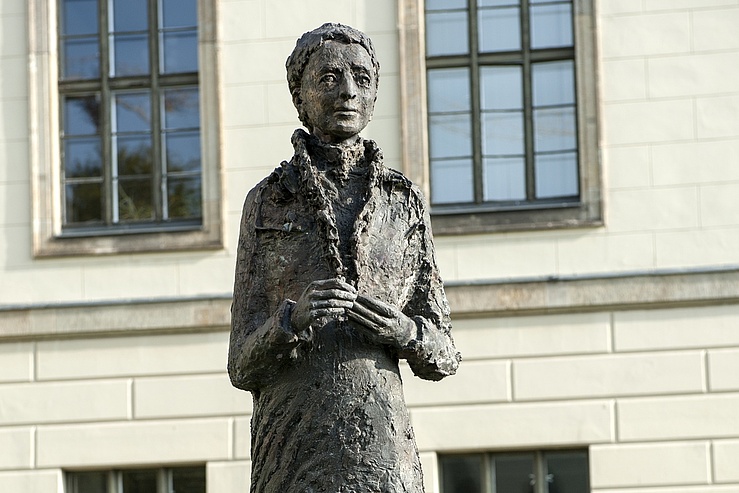
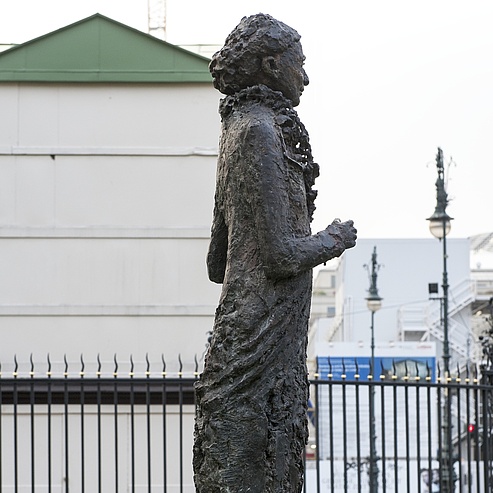
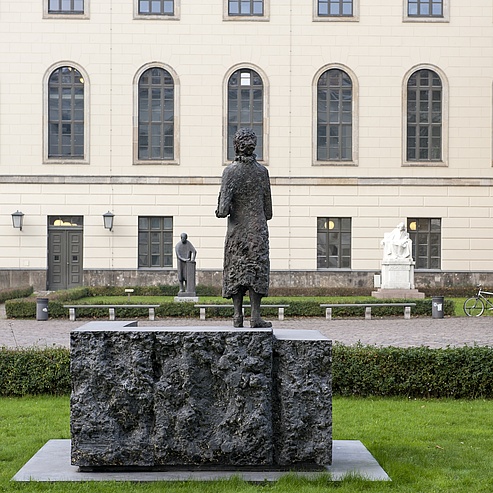
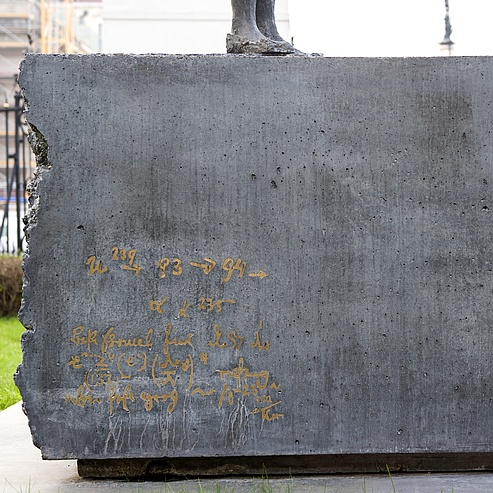
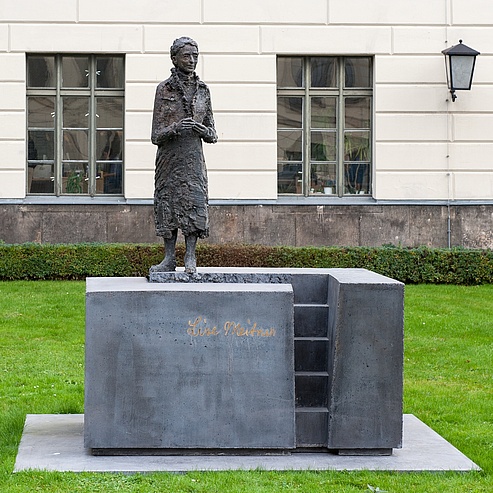
Since 2014, Lise Meitner faces Unter den Linden; on the other side of the cour d'honneur of the main building, Theodor Mommsen and Max Planck face her. The monument to Hermann von Helmholtz completes the historical series, which is broken up and continued both in terms of contemporary history and aesthetics by Lise Meitner's representation - no longer larger than life and in a space-consuming pose, but set back and asymmetrically on the plinth. Lise Meitner (1878-1968) combines many special features in her scientific biography: she was the second woman to receive a doctorate in physics from the University of Vienna in 1906; in 1913 she was the first woman to become a scientific member of the Kaiser Wilhelm Society; she was the first woman to work as an assistant to Max Planck; in 1922 she became the first female physicist in Prussia to habilitate at the University of Berlin; and finally, in 1926, she was appointed as the first associate professor for experimental nuclear physics. In retrospect, she herself describes the fact that she took her work with the students very seriously as "a great human responsibility for our young colleagues, with whom we are together all day and for whose overall human development everything we do and say can have an influence".
Nuclear power for peaceful purposes
Even before her theoretical interpretation of nuclear fission in 1939, she received the first of a total of four nominations for the Nobel Prize in 1919 - but she did not receive the Nobel Prize itself. This honour was bestowed on Otto Hahn in 1945, with whom Lise Meitner worked and researched together for decades - and whom she sometimes referred to, self-confidently teasingly, as "chicken". She became known to the scientific community early on and met Marie Curie and Albert Einstein personally. As a Jew, she was forced to give up her scientific work by the Nazi Law for the Restoration of the Professional Civil Service, which was passed in 1933. In 1938, she was able to emigrate to Sweden. There, from 1947 to 1960, she held a research professorship and was head of the nuclear physics department at the Stockholm Institute of Technology. From then on, she devoted herself not to the construction of the atomic bomb, but to the peaceful use of nuclear energy. After her retirement in 1960, she moved to Cambridge, where she died eight years later, having received many international honours and awards.