A relief depicting the Swiss Alps, measuring 14 square metres, was once one of the main attractions of the Kunstkammer in Berlin Palace. A section of the model was identified a few years ago and can now be viewed at the Humboldt Forum.
How a Swiss craftsman created the model of the Aletsch Glacier and it came to the university
The relief model of the Swiss Alps consisted of ten sections and provided an overview of mountain ranges and valleys in previously unseen accuracy. A section of the model was found and recognised in a database a few years ago by a doctoral student at the Institute of Geography. It is now in the Humboldt Forum and can be viewed there.
On 10 May 2017, a small group of scientists from various disciplines met in a room on the top floor of the Institute of Geography in Adlershof. They wanted to check whether the art historian Eva Dolezel was correct in her assumption about a topographical model. Dolezel had written her dissertation on the historical Kunstkammer of Berlin and in the process had come across parts of an outstanding object that drew Berliners to the former palace where the Kunstkammer was housed over two hundred years ago: a relief of the Swiss Alps. Evidence shows that Alexander von Humboldt was also very taken with the model, which consisted of ten parts and was about 14 square metres in size.
How the relief was created and came to be in the Kunstkammer
The work was created by Joachim Eugen Müller (1752-1833), a craftsman from the canton of Obwalden (Part of Switzerland), whose knowledge of the Swiss Alps was outstanding and who possessed an incredible spatial imagination to form a topographically almost exact image of the mountains in miniature without any existing map material. And he didn't just create one. Many wanted such a work of art at the time. Among the many, and the few who could also afford it financially, was King Frederick William III of Prussia. Thus, in the course of the first quarter of the 19th century, a relief in matching individual parts came to Berlin and was placed in the Kunstkammer there and was open to the public.
The relief was made of a plaster mixture, enclosed in a wooden frame and painted on the surface with green for woods and meadows or white for snow and ice according to the natural local conditions. Towns, rivers, lakes and glaciers were visible. What remained hidden from the view of the observer were metal pins that Müller attached to the wooden panel at the point where he later shaped the higher peaks. This detail allows us today to identify the model as the "real Müller".
From the database via the doctoral thesis to the Humboldt Forum
With the dissolution of the Kunstkammer, the trace of the relief was lost. In 2010, a project was launched at the HU to record material models in university collections nationwide. In the process, a mountain relief called "Model of the Upper Rhone Valley with Aletsch Glacier" was added to the publicly accessible database. Eva Dolezel discovered it there and put one and one together. Her conclusion: the model in the Geographical Institute must very probably be part of the historical Alpine relief in the Berlin Kunstkammer. And this assumption was ultimately confirmed.
The subsequent attention led to a second career for the relief. Today it is on display in the Humboldt Laboratory, but it is also part of the exhibition "Traces. History of Place" exhibition at the Humboldt Forum. It can be visited during the usual opening hours. The relief can serve as a good example of the limitless potential of many previously undiscovered objects in university collections. And the group of researchers mentioned at the beginning has not yet given up hope that perhaps more pieces of the former Swiss Alpine relief will be discovered.
The Object of the Month presents selected items from the collections and research areas of the Centre for Cultural Technology. The focus is on an object that offers insights into material culture, the history of the collection and academic contexts. The articles shed light on the origin, design and significance of the objects and demonstrate the questions they raise. In this way, they open up new perspectives on historical developments, cultural practices and current research interests relating to the material artefacts of the University and its collections.
On 9 December 2026, there will be a launch for the book *German Colonialism and the Law*, which has just been published by Pretoria University Law Press. The event will begin at 6.00 pm in Room E25.
As part of the Oxford-Berlin Symposium ‘Global Challenges from a European Perspective’, Prof Jeßberger will be chairing a panel on 10 November 2026 featuring, amongst others, Dr Kalika Mehta and Prof. Dr Andy Hurell.
The Japan Society for the Promotion of Science (JSPS) research fellowship supports highly qualified postdocs from Germany, regardless of their field of study, in their research projects in Japan.
The Daimler and Benz Foundation is providing funding of up to 300,000 euros over three years to support research partnerships between German and African institutions. German research institutions can apply under the ‘Ladenburg Horizons’ programme.
The research centre is celebrating its anniversary: A series of seminars and panel discussions will explore influential contributions to the humanities and social sciences, as well as the development of a Franco-German research space.
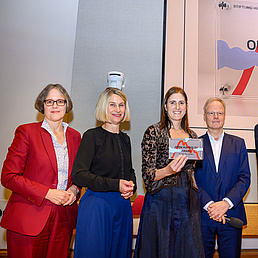
Prof. Dr Petra Anders from the Department of Education Studies was presented with the first Open Humboldt Award on 2 November. The award recognises researchers at HU who make academic topics accessible to a wider public.