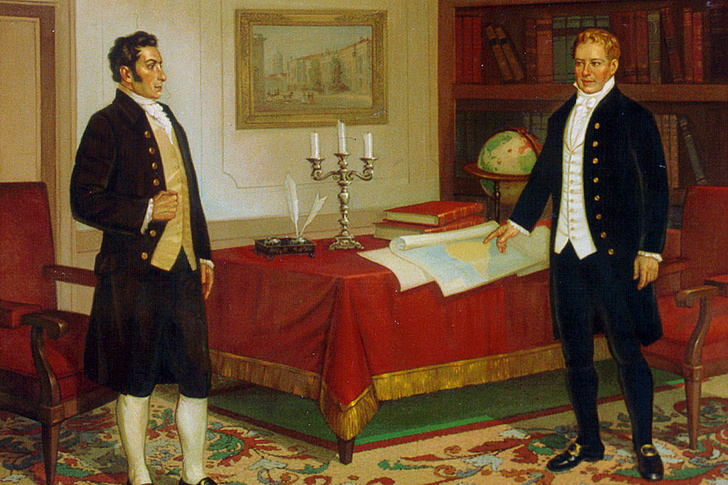
Two men stand facing each other in a room at a respectable distance. Both seem to have risen from the armchairs behind them. While the man on the right can be recognised as Alexander von Humboldt by a bookcase, a globe and maps on the table, but also by his well-known physiognomy, the other man initially remains anonymous. Humboldt points to the South American continent on the map hanging half over the edge of the table. Thus the interior is about the encounter between Alexander von Humboldt and Simón Bolívar. While Humboldt looks at the famous revolutionary leader with half curiosity, half reservation, the latter seems to look past him and into the future with his chest stretched proudly.
Simon Bolivar and Alexander von Humboldt
A historic yet staged encounter, and a picture within a picture – or how a gift came to the HU.
From Peru to the HU
Two meetings between Humboldt and Bolívar did indeed take place - in the summer of 1804 in Paris and in 1805 in Rome, thus after Humboldt's great journey to America. However, they did not take place in intimate togetherness, nor did they happen against the backdrop of Latin America's efforts to gain independence from the Spanish empire, which did not begin until around 1808. At that time, Bolívar was still a womaniser without political vision and Humboldt had only been able to make his journey with the permission of the Spanish King Charles IV. The myth of Humboldt as the “scientific father of political independence” (Zeuske 1999-2000, p. 129) was already built up by contemporaries, just as Bolívar's struggle for equality, agrarian reforms and against slavery was dressed up as a myth of "continental unification of the countries of the South against 'the North'" and he was revered as the hero of a Venezuelan nation (Zeuske 2011, p. 12). Both resulted from the fact that the revolution had brought the colony of Venezuela a new state order, but with new elites who continued the old colonial economic and social order in their own way (ibid., p. 15). In 1984, however, the myth still seemed to work; the painting by Etna Velarde was given to Erich Honecker by the Peruvian Communist Party - in 1824 Bolívar's troops had ended Spanish colonial rule in Peru as well. Honecker gave the work to Humboldt University, where it was hung at the entrance to the Audimax in 1984. Today, like many works from this period, it is housed in the magazine. We also encounter Alexander von Humboldt as the "second discoverer of Cuba", namely through the inscription on the base of the statue in front of the main building, written and donated by the University of Havana as early as 1939.
The artist Etna Velarde (1940-2014), who became famous in her native Peru as a teenager, often devoted herself to historical themes and persons, for which she frequently searched for sources, oral and written testimonies and scoured photo archives, war reports and books. What is striking here is the great fidelity to portraits of Humboldt and Bolívar, comparing other representations of the two men in paintings, prints and on medals. The portrayal of their own history and ethnic identity follows the myths that are still effective today, but as a historical scene it is portrayed in an equally distanced manner.
Literature:
- Michael Zeuske: Humboldt und Bolívar, in: Frank Holl (Ed.): Alexander von Humboldt. Netzwerke des Wissens, exhib. Berlin/ Bonn 1999-2000, pp. 128-129;
- Michael Zeuske: Simón Bolívar. Befreier Südamerikas – Geschichte und Mythos, Berlin 2011.

Series: Artwork of the Month
The Artwork of the Month showcases selected pieces from the art collection. Each month, one or more objects are highlighted to provide insights into material culture, the history of the collection and academic contexts. The articles examine the provenance, design and significance of the objects from various angles and highlight the broader issues they raise. In this way, they open up new perspectives on historical developments, cultural practices and current research interests associated with the art collection.

Topics:
