

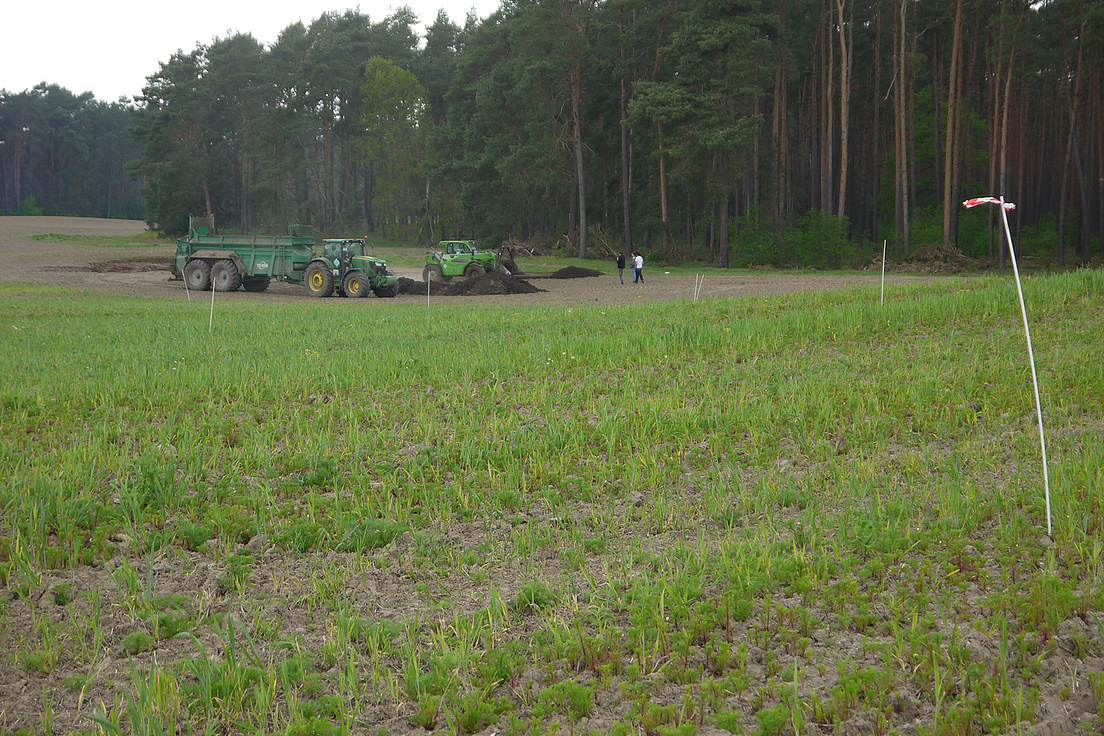
Human faeces could play an important role in sustainable agriculture. A research team from Humboldt-Universität zu Berlin (HU) and the Eberswalde University for Sustainable Development (HNEE) has investigated under field conditions how safely hygienised human faecal compost can be applied. The microbial risks to human health were investigated to ensure that pathogens from human excrement cannot enter the food cycle through fertilisation and the subsequent production of food. The results of the field trials indicate that coarse-grained sandy soils are suitable for the application of quality-assured fertilisers and that there is no risk from pathogens in the soil.
Circular economy instead of waste
According to the Fertiliser Ordinance, human excrement in Germany may only be used for research purposes, but not in agriculture, because it is currently assumed that pathogens and other pollutants accumulate in soils and crops due to insufficient hygienisation. On the other hand, human faeces have the potential to recycle nutrients and save water and energy as part of the circular economy. In addition, such fertiliser can help to store carbon in the soil and thus protect the climate.
Positive results in practical tests
In their study, a team of scientists led by Prof. Dr Timo Kautz (HU) and Prof. Dr Roland Hoffman-Bahnsen (HNEE) tested fertilisation with a double heat-treated and quality-assured compost over a period of between just under two months and more than three years. The concentration of the bacteria Escherichia coli, enterococci, salmonella and Clostridium perfringens in the soil was analysed. They are regarded as suitable indicator organisms to indicate health risks from faecal contamination. HU scientist Jan-Ole Boness was responsible for the experiments. "We are doing pioneering work in our real laboratory to make the effect of the fertiliser measurable in practice," explains Jan-Ole Boness. "The well-treated compost proved to be a safe fertiliser. No systematic increase in indicator germs could be found." For the fertiliser, faeces from dry toilets were heated to 70 degrees Celsius for seven days and then composted with other additives at high temperatures for ten weeks. Data to date has mainly come from laboratory tests, the conditions of which differ greatly from those in the field.
Future studies will have to investigate how repeated fertilisation over many years and on different soil types affects the soil microbiome. The aim is to create a scientific basis for modernising the legal framework for a sustainable circular economy in agriculture.