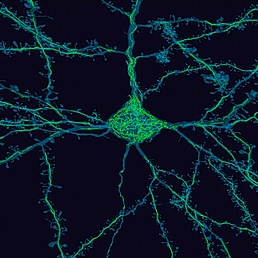
International researchers have analysed the distribution of mitochondria, the energy producers of cells, in the brain. The results offer new perspectives on the organisation of neuronal networks and their performance.
The "Affective Aesthetic Cognitivism and Wonder" project, which investigates the central role of wonder in aesthetic experiences and in the cognitive process, is being funded with two million euros.
On 1 December 2025, Florian Slogsnat was awarded the Tiburtius Prize of the Berlin universities for his outstanding doctoral thesis. This recognition prize for excellent dissertations is awarded annually by the LKRP.
The University Health Management (HGM) invites all employees and students of Humboldt-Universität (HU) to take part in the anonymous online survey "How are you doing at HU?" until 14 December.
The Moodle course "Working, teaching and studying inclusively" raises awareness of accessibility and inclusion. It offers information, contact persons and practical modules for reducing barriers at the HU. (German language only)
Clean Energy Valley in northern Germany is becoming a leading European location for renewable energies. The BMFTR project KoReGio100 is researching in a real-world laboratory how this transformation can be achieved co-creatively and sustainably with…
Academic freedom is considered secure. Yet even in Germany, tendencies towards self-censorship exist, and they can reshape public discourse. Universities have to defend the freedom of research and to empower their researchers to do the same.
The German Research Foundation (DFG) has approved a second funding phase. Humboldt-Universität is involved in the Research Training Group with three researchers.